In-vehicle communication & control architecture
Control the vehicle as a single entity, in real time.
ASG is a real-time operating system with its own ECU hardware and communication protocol. Every electromechanical node in the vehicle is committed to one shared state, every millisecond.
The platform
The infrastructure layer for the software-defined vehicle
Today's vehicle is a network of independent parts exchanging messages. Forty to a hundred ECUs, several incompatible buses, and a harness that grows with every feature added. Each new function means new hardware, new bandwidth, new message definitions, and a new timing problem to validate.
ASG replaces that with a single foundation. Every electrical node in the vehicle joins one network and becomes part of one control system. The whole electrical state of the vehicle is committed synchronously, every millisecond, and any function written on top of ASG addresses that single state rather than negotiating with forty separate parts.
t = 00:00.000 · 92 nodes committed · 0 µs skew · 1000× dilated
-
Universal
Any electrical node of the vehicle is included in the network and acquires smart capabilities. There is no category of device that needs a gateway, a translator, or a bus of its own. One protocol reaches everything.
-
Modular control blocks
Control units are universal rather than function-specific. The same block serves a different role depending on where it sits and what software it runs. Fewer unique part numbers, simpler supply chain, simpler service.
-
Super-scalar infrastructure
Computation is distributed across chips throughout the vehicle volume and runs time-parallel rather than sequentially. Processing capacity scales by adding blocks, not by specifying a larger central computer.
-
Feature development speed
A new function is software written against a known, complete vehicle state. No new ECU to specify, no bus bandwidth to allocate, no message set to define, no harness change to route. Development time drops from hardware timescales to software timescales.
-
Cost at platform scale
Fewer unique control units, 200–300 m of wiring instead of 2–3.5 km, and less integration labour per vehicle. The saving compounds across a platform and across a model cycle rather than applying to one vehicle in isolation.
-
Ready for autonomy
Autonomous control needs to know the true state of the whole vehicle at a known instant. ASG provides exactly that: every parameter, timestamped to the same millisecond, with a bounded 1 ms reaction time and a 10 µs internal block response.
Changing the game for future feature development
Adding a feature today
- 1 Specify a new ECU
- 2 Allocate bus bandwidth
- 3 Define the message set
- 4 Route new harness
- 5 Integrate across suppliers
- 6 Validate timing across buses
Adding a feature on ASG
- 1 Declare the node
- 2 Write the function
The network is the platform. Once a node is on ASG, it is already addressable, already timestamped, already part of the shared state.
Figures are vehicle-dependent. Each is derived on the methodology page.
Comparison
Speed is not synchronisation
Automotive Ethernet is fast. On a lightly loaded network it can deliver a single event sooner than ASG does. What none of CAN, LIN or Ethernet does is guarantee when, or guarantee that every zone holds the same state at the same instant. Arrival depends on what else is on the bus at that moment.
ASG is not competing on peak speed. Every event lands on the same 1 ms grid, and on each commit every zone module holds one shared, complete picture of the vehicle. For a control system, knowing exactly when, with full control of state, is worth more than sometimes being faster.
- ASG vs CAN / CAN-FD Arbitration and priority give CAN variable latency under load. ASG removes both.
- ASG vs LIN LIN polls each slave in turn. ASG needs no master node and no separate sub-bus.
- ASG vs FlexRay FlexRay adds a static schedule to configure. ASG is time-triggered by construction.
- ASG vs Automotive Ethernet Ethernet is fast, but switch queueing spreads its tail. The ASG grid never varies.
The protocol
An ISO-compliant seven-layer protocol
- 1 Physical Modified OFDM. Each module carries a frequency identity, a diad, on one shared medium.
- 2 Frame The frame descriptor: which module owns each value, and its frequency identity.
- 3 Network One broadcast domain. Every value has exactly one writer; every module reads all.
- 4 Transport The master clock commits the shared information window, every 1 ms.
- 5 Session Convolutional, error-resistant coding, and its matching decode.
- 6 Presentation Redundancy and integrity protection for the committed state.
- 7 Application Features run in parallel against the one committed vehicle state.
- Universal
- Any electrical node of the object is included in the IT network and acquires smart capabilities. The node becomes part of the vehicle's unified digital control system.
- Accurate
- Real-time operation and advanced information storage and processing form a holistic picture of all object parameters every millisecond, including every electromechanical parameter of the system nodes, each timestamped to a specific moment in time.
- Efficient
- The communication channel operates in real time and is an integral part of the control system rather than something the control system is layered on top of. Complex control systems built over standard communication systems make the control layer secondary; ASG does not.
- Distributed
- The channel enables a smart network with time-parallel computation performed on chips and blocks distributed throughout the control object's volume, which is promising for prototyping and creating new multi-core chips with parallel data processing.
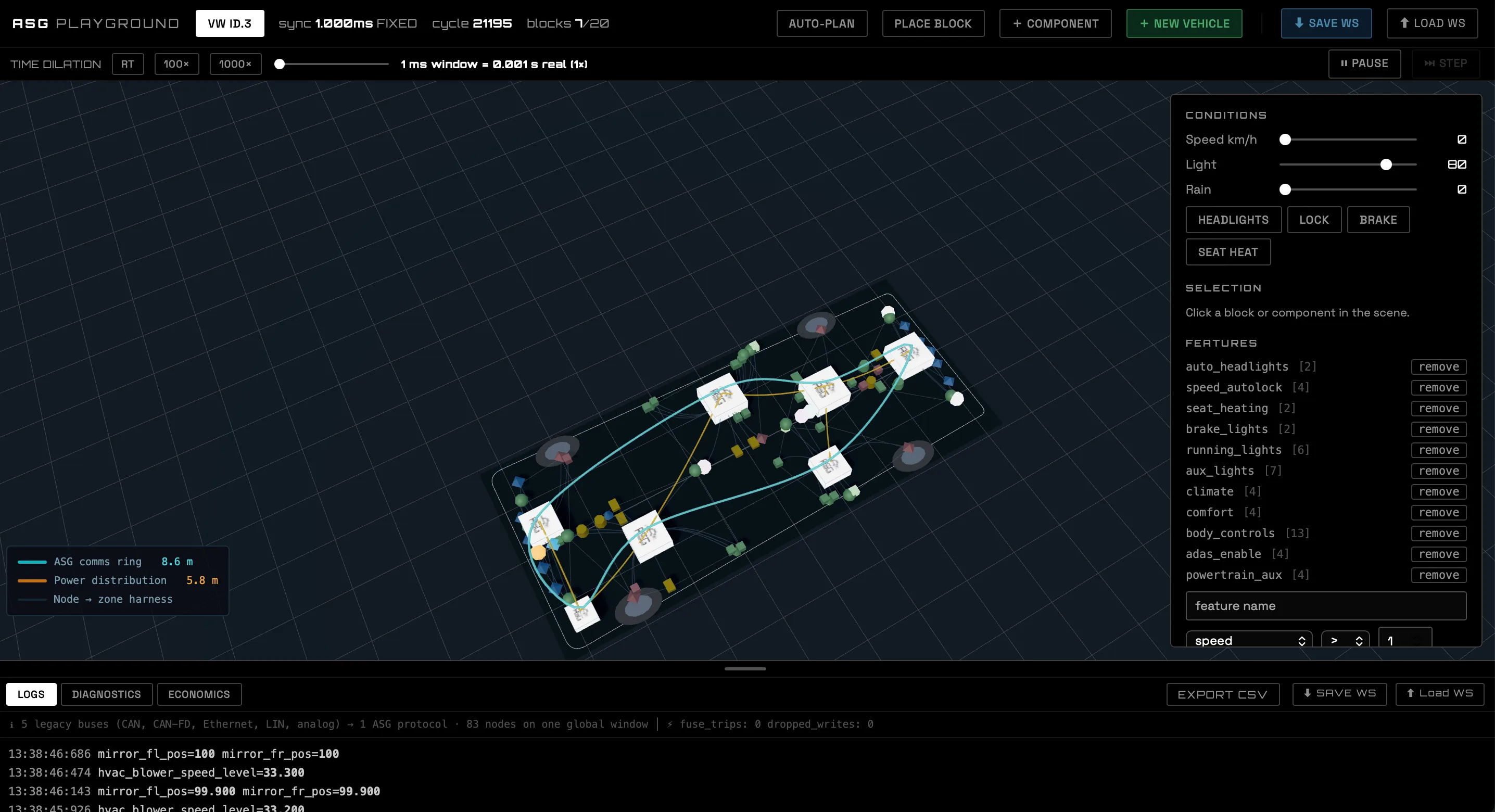
The simulator
Map your own vehicle on ASG. Free.
Build your vehicle's electronic architecture node by node. The simulator maps it automatically onto the ASG protocol and shows you what the result looks like: the full wiring harness, the number and placement of control blocks, live logs and diagnostics, and the economics for that specific configuration.
It is a playground for tailoring ASG to a real vehicle. Add features and watch how they behave on the network. Dilate time and watch the synchronous window commit.
- Build your architecture node by node, or start from a template
- Automatic mapping onto the ASG protocol
- Full wiring harness topology and length
- Control block count and placement
- Real-time control and live diagnostic logs
- Time dilation: observe the 1 ms synchronous window
- Economics and material summary for your configuration
Where we've been
Live demonstrations across the industry
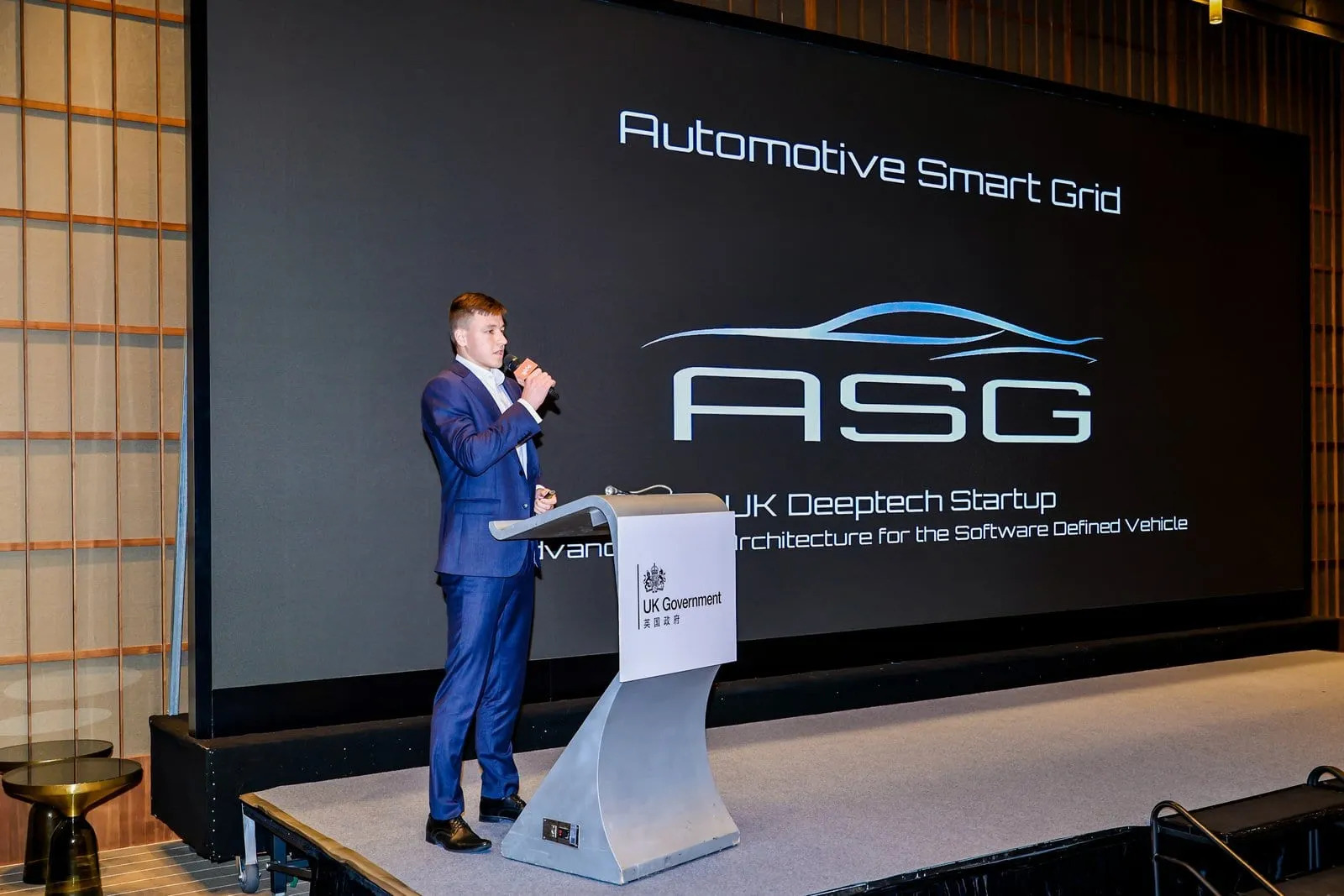
- Conference World Intelligent Connected Vehicles Conference Visits to Li Auto, Xiaomi, Pony.ai and WeRide, and a keynote at the WICV Application Ecosystem Forum.
- Trade mission SMMT trade mission to the USA Six direct OEM meetings at the Southern Automotive Conference, visits to CU-ICAR and SCTAC, and a BMW plant tour.
- Trade mission DBT trade mission to China ASG on the UK Department for Business and Trade delegation to two of China's automotive centres.
- Summit Automotive E/E Systems Summit ASG presented as an alternative lower-level E/E architecture to the room.
Beyond automotive
The same architecture, other domains
ASG controls any group of distributed electromechanical nodes joined by a single energy network. Vehicles are the primary focus; these are examples of where else the architecture applies.
- Aerospace Distributed actuation and sensing across an airframe, with deterministic timing and reduced harness mass.
- Spacecraft Bounded-latency control of subsystems where mass, wiring and fault isolation are at a premium.
- Robotics Synchronous control of many joints and sensors as one system rather than a network of controllers.
See how ASG can impact your vehicle
Map your architecture in the simulator, or talk to us about a pilot vehicle and a live system demonstration.