Articles Hello, Auto!
The missing volt in the copper-to-aluminium wiring story
Aluminium vehicle wiring is an economics story on the surface and a voltage-budget story underneath; 48-volt zonal architecture is what actually moves the line.
12 August 2026
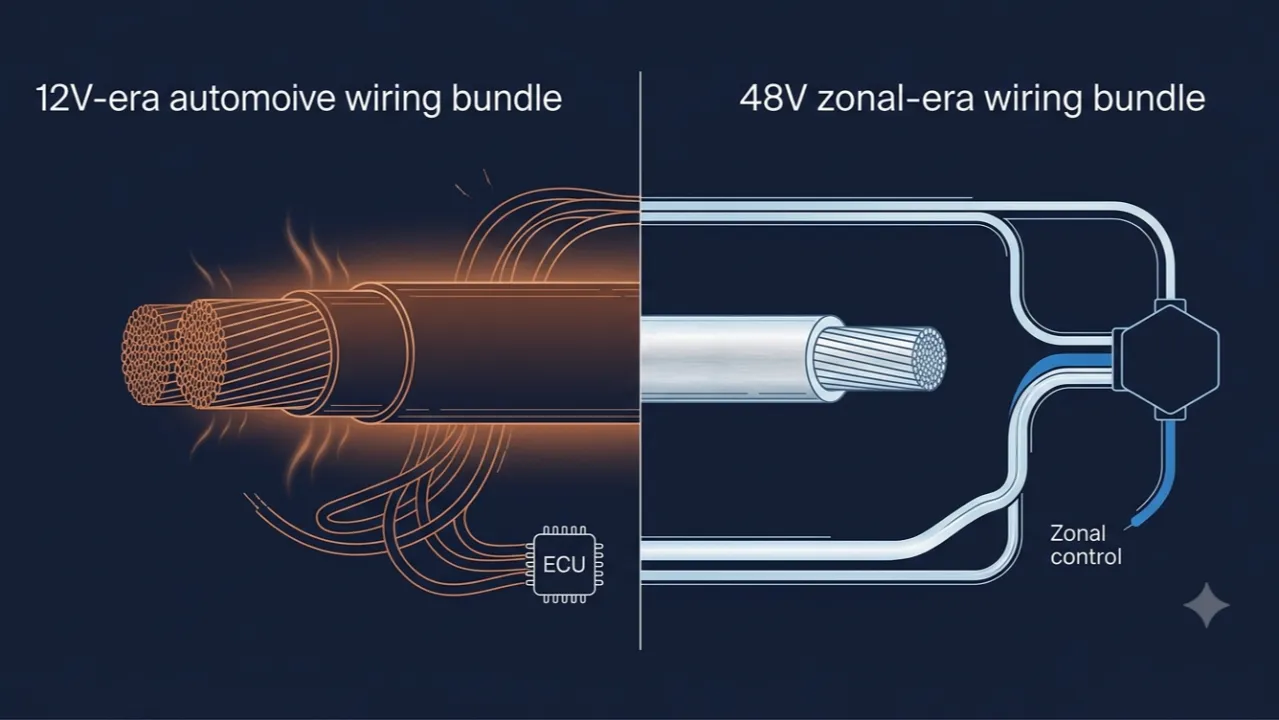
Every account of why carmakers are quietly swapping copper wiring for aluminium tells the same story. Copper has been trading at roughly 3.5 times the price of aluminium per equivalent volume for several years running, aluminium weighs about 30% as much as copper for a given length, and cutting harness weight has an outsized effect on range because a lighter harness needs a smaller battery to hit the same performance target. Ferrari has reported a 15 to 20% wiring-weight reduction from aluminium power cables in its 296 hybrid and Luce EV platforms. BMW has run aluminium conductors through its eDrive systems since 2011. Tesla builds aluminium wiring into the Model Y and the Cybertruck. It is a tidy economics story, and it is true as far as it goes.
It does not go far enough. What it leaves out is the reason aluminium has spent a decade confined almost entirely to high-current power cables, battery-to-motor runs and busbars, while staying out of the safety-critical control wiring that keeps a vehicle's electronics alive through a transient. That reason is electrical, not financial, and it is only now starting to shift, not because of the copper price, but because of a change in system voltage.
The conductivity aluminium can't shake off
Aluminium's electrical conductivity sits at roughly 61% of copper's on the IACS standard. Practically, that means an aluminium conductor needs a larger cross-section than a copper one to carry the same current without excessive resistive loss, and a given aluminium wire will drop more voltage over the same run length than an equivalent copper wire would. This is not a manufacturing quirk that better alloys quietly fix; it is the underlying physics of the two metals, and it is why the industry's actual practice has been a hybrid strategy rather than a wholesale swap: aluminium where routing allows a larger diameter and the circuit is tolerant of extra resistance, copper everywhere the margin is tight. By most current estimates, around 85% of EV battery-connected wiring and busbars remain copper. The substitution has been real but narrow.
The narrowness is not an accident of conservatism. Conventional 12-volt vehicle electrical systems already operate close to the edge of their voltage budget under transient conditions. During a cold-crank event, battery voltage can sag to somewhere between 4.5 and 6 volts for tens of milliseconds depending on temperature and severity classification, and electronic control units sitting near that threshold risk a brownout reset or a loss of stored state. Every additional millivolt of resistive drop introduced by a wiring change eats into a margin that automotive electrical engineers have spent decades trying to protect, which is exactly why aluminium has stayed out of the wiring that feeds time-critical control functions. The economics of aluminium were never really in doubt. The voltage budget was the constraint.
What 48 volts actually buys
That constraint is what the industry's move to 48-volt zonal architecture changes, and it changes it as a side effect rather than as the point of the exercise. The primary reasons carmakers are adopting 48V zonal systems are wiring mass, cost and the deterministic, zone-local control that software-defined vehicle platforms need. But the same voltage increase that shrinks harness mass also multiplies the resistive margin available to spend on conductor choice. For an equivalent 1,200-watt load, a 12V system needs 100 amps; a 48V system needs only 25 amps. Because resistive loss in a wire scales with the square of the current flowing through it, halving current alone cuts wire loss by a factor of four, and cutting it to a quarter compounds that further. Vicor's own worked example of a 48V zonal power-distribution design shows power losses cut by 60% relative to a centralised 12V architecture, alongside cables that are physically smaller, lighter and easier to route.
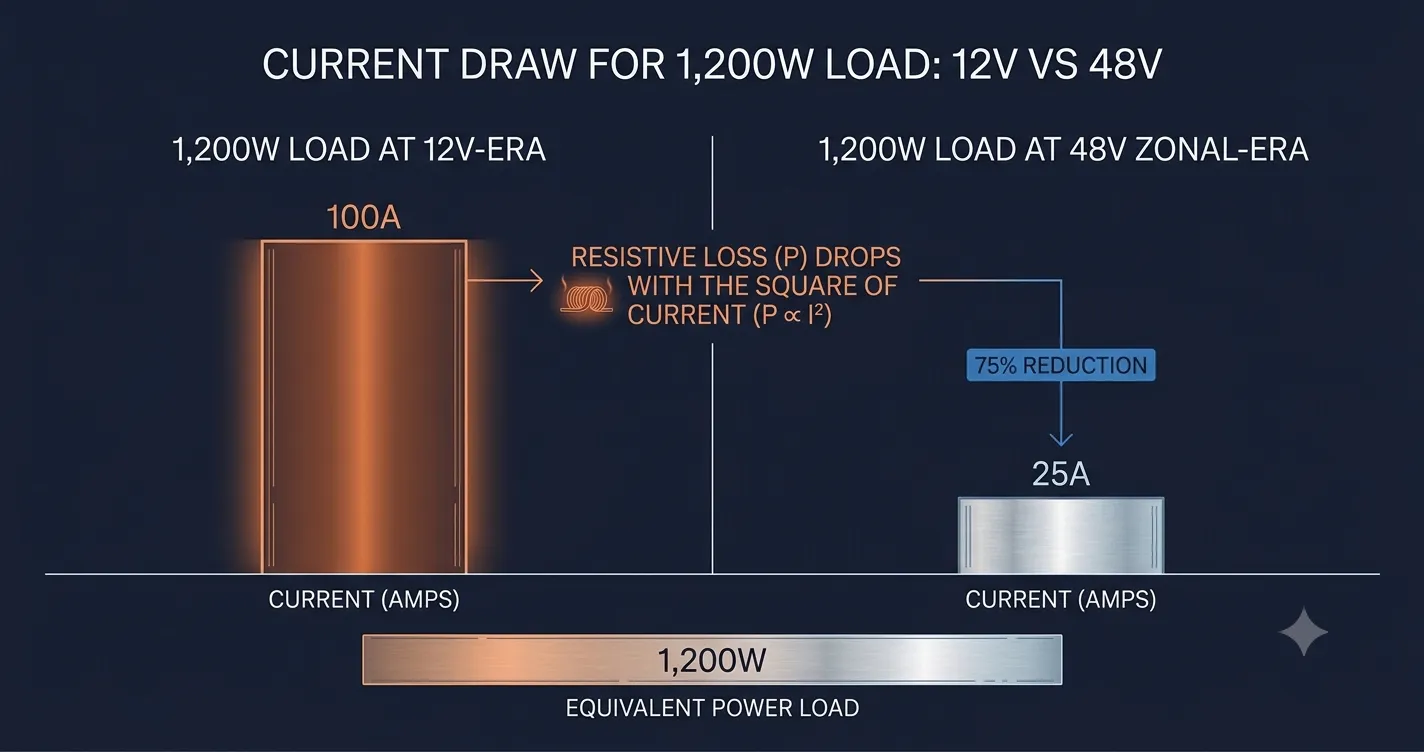
That recovered margin is a currency, and carmakers can spend it two ways: on thinner copper, for straightforward weight and cost savings, or on aluminium at existing gauges, extending its economics into circuits that a 12V budget could never have tolerated. This is happening in named, dated hardware now. Ford's Universal EV Platform, announced on 11 August 2025, introduced the company's first 48V low-voltage system, developed in-house following its 2023 acquisition of Auto Motive Power, and it strips out 4,000 feet of cable and roughly 22 pounds of wiring weight while explicitly cutting copper use. The resulting midsize electric pickup, priced near $30,000, is due in 2027. NXP's CoreRide Z248, a pre-validated 48V zonal reference system built on its S32K5 microcontroller and expected to be widely available by the end of 2026, goes further: NXP markets it explicitly as combining 48V power distribution with deterministic data handling, functional safety and real-time responsiveness in a single validated stack, treating voltage domain and control determinism as one engineering problem rather than two.
What to watch
None of this means aluminium is about to take over safety-critical wiring wholesale. Aluminium's higher susceptibility to oxidation at connection points, and its weaker fatigue resistance under repeated flexing and vibration, remain real constraints regardless of system voltage; door harnesses and seat-adjustment wiring are unlikely aluminium candidates for a long time yet. The automotive industry has also already built qualification infrastructure for the aluminium it does use: SAE/USCAR-38 specifies test methods and performance criteria for ultrasonically welded wire terminations across aluminium sizes from 0.5 to 150 square millimetres, evidence that this is a bounded, engineered substitution rather than an improvised one.
The genuinely open question for 2026 and 2027 is narrower and more interesting: does aluminium start appearing inside the zonal control wiring that 48V stacks like CoreRide Z248 are built to make deterministic, or does it stay confined to the power-only circuits it has occupied for the past decade, even as the voltage budget that once excluded it loosens. Volkswagen and Rivian's joint zonal software-defined-vehicle architecture, currently in winter testing with first production use planned in the Volkswagen ID.Every1 from 2027, is one of the platforms worth watching for a signal either way, alongside whether termination standards bodies extend aluminium-specific guidance beyond today's power-cable-focused scope as 48V zonal architectures move from reference design to volume production.
Given that the voltage-domain shift, not the copper price, is what actually governs where aluminium can go next, should functional-safety documentation for 48V zonal platforms start specifying conductor material as an explicit input to the voltage-margin budget, the way it currently treats connector ratings and wire gauge?
This piece first appeared in ASG's Hello, Auto! newsletter on LinkedIn.