Articles Hello, Auto!
The 202-millisecond ceiling: why a robotaxi's human backup runs into the same physics as its autopilot
A robotaxi's remote human backup is bound by the same perception-to-actuation latency budget as the autopilot it is meant to catch, and the crash record shows it.
29 July 2026
In May, a Tesla Model Y robotaxi got itself stuck on a dead-end residential street in Houston. A remote assistance operator, sitting somewhere else entirely, took over to reverse it out. The car rolled onto a grassy slope and, at a recorded pre-crash speed of 2 mph, drove into a hidden tree stump. Nobody was hurt and the damage was minor. But the incident, disclosed in Tesla's NHTSA filings and reported on 20 July, was the third time in a year that a Tesla teleoperator has taken direct remote control of a stuck robotaxi and crashed it. Three interventions, three collisions.
The instinctive read is that this is a training problem, or a staffing problem, or simply bad luck. It is neither. It is a control systems problem, and it is the same one that makes autonomous driving hard in the first place. The industry has built remote human assistance as the safety net beneath the autonomy stack, the thing that catches a robotaxi when its software gets confused. What two years of network measurement research now show clearly is that a human operator connected over a cellular link is bound by the same real-time latency budget as the vehicle's own perception-to-actuation loop. Moving the decision-maker from silicon to a person at a screen does not remove the constraint. It just changes who has to fight it.
The budget nobody escapes
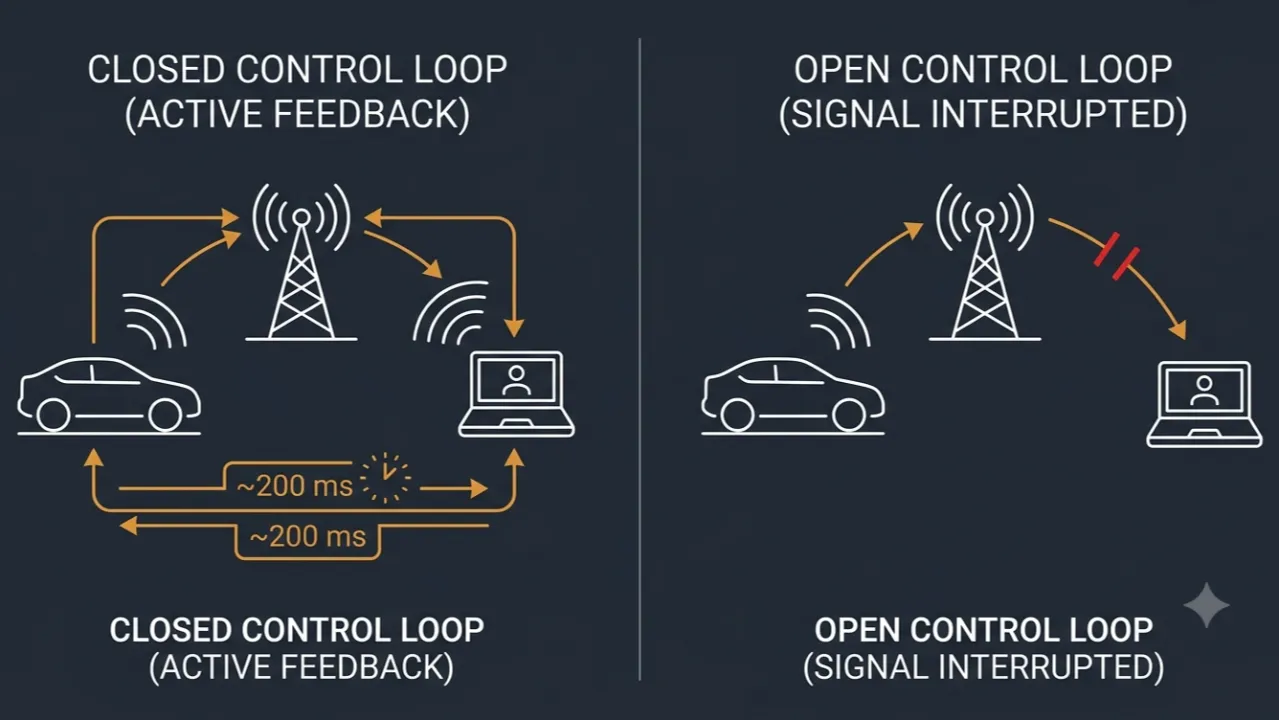
Teleoperated driving depends on closing a loop: a camera captures the road, the image is encoded, transmitted, decoded and displayed to a remote operator, who reacts and sends a control command back, which the vehicle then has to physically execute. Researchers measure this in three parts. Glass-to-glass (G2G) latency covers the trip from camera to the operator's screen. Round-trip time (RTT) covers how quickly a command sent from the operator reaches the vehicle and gets acknowledged. Motion-to-motion (M2M) latency covers the final, often-overlooked step: how long it takes the steering and drivetrain to physically realise the command once it arrives.
A 2025 experimental study from the University of Luxembourg's SnT research centre, using a modified Kia Soul EV on a private 5G network, measured an average G2G latency of 202 milliseconds and an average RTT of 47 milliseconds, with steering actuation lag reaching as high as 750 milliseconds in some samples. That is under close to ideal conditions: a dedicated 5G connection, a purpose-built drive-by-wire vehicle, and a controlled test area. A follow-up study from the same group in early 2026, this time measuring performance over ordinary commercial 4G and 5G networks rather than a private testbed, found average end-to-end latency closer to 500 milliseconds, with the motion-to-motion component alone accounting for up to 60% of that figure.
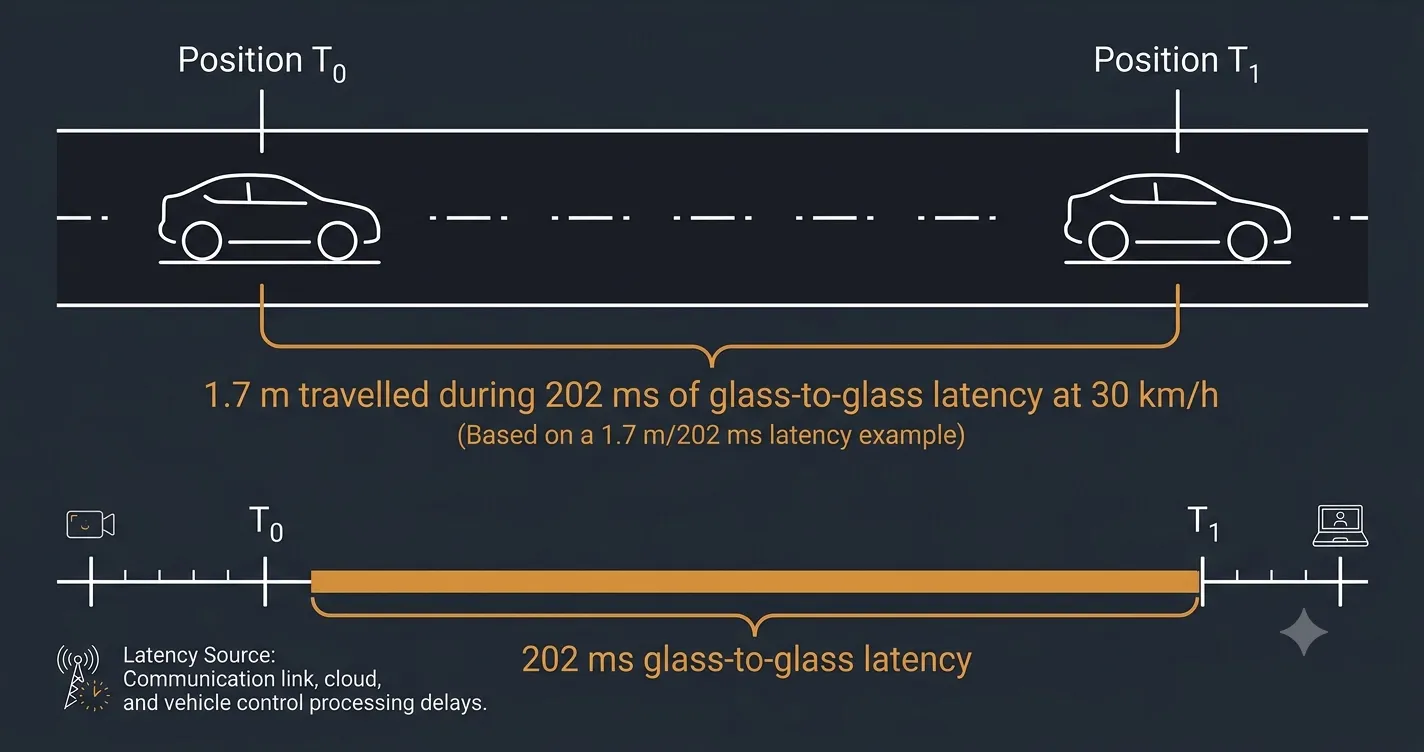
Put a number to what 202 milliseconds actually costs. A vehicle travelling at 30 km/h covers roughly 1.7 metres in that time, with no fresh visual information yet on the operator's screen. Add the actuation lag on top and the real gap between what the operator sees and what the vehicle is doing at any given instant grows further still. The Luxembourg researchers concluded their own system was safe for teleoperated driving only below roughly 20 km/h. That is not a policy choice. It is what the physics of the network and the vehicle's actuators allow.
Two answers to the same constraint
Robotaxi operators have responded to this ceiling in genuinely different ways, and the difference is architectural rather than cosmetic. Waymo has told Senator Ed Markey, in a letter made public this year, that it "has not used remote driving or 'teleoperations' where a human performs the Dynamic Driving Task" on US roads. Its remote staff, roughly one for every 40 vehicles according to figures Waymo has disclosed, can only advise: the onboard system, which Waymo calls the Waymo Driver, retains real-time authority and can accept or reject any suggestion. The one function that comes close to direct control, a fixed-steering-angle nudge at 2 mph to free a stuck vehicle, operated only by specially trained US-based staff, has, in Waymo's own words, "never been used outside of training."
Tesla has built the opposite architecture. Its teleoperators are authorised to physically steer and accelerate a stuck Robotaxi by remote link, capped below 10 mph, specifically to reposition vehicles that its automated driving system cannot get out of trouble on its own. This is a closed loop in the strict control-theory sense: the human is inside the vehicle's control path, not advising an authority that sits elsewhere. And it is precisely this closed loop that produced the three crashes now on the public record: Austin in July 2025, where a teleoperator drove a vehicle up a kerb into a metal fence at around 8 mph, injuring a safety monitor badly enough to require hospital treatment (the only hospitalisation across Tesla's entire 17-incident public dataset); Austin again in January 2026, into a construction barricade at around 9 mph; and the Houston tree stump in May.
What the crashes actually show
None of the three involved a connection loss. That distinction matters. Carnegie Mellon safety researcher Philip Koopman warned before the Austin launch that Tesla's approach was "inherently unreliable technology" specifically because a dropped connection would eventually strike at the worst possible moment; former Waymo chief executive John Krafcik made a similar point about the risk of remote driving at speed. Both were describing a failure mode that has not yet appeared in the public data. What has appeared is something research increasingly explains on its own terms: a 2024 study using functional near-infrared spectroscopy on 41 human subjects found that latency in teleoperation measurably raises cognitive load and anxiety and degrades motion planning, independent of any outright signal failure. A restricted camera view, a compressed sense of distance, and a control loop running 200 to 500 milliseconds behind reality appear to be enough on their own to produce the kind of misjudged manoeuvre that put a robotaxi into a fence, a barricade, and a tree stump.
What to watch
The obvious missing number is how often this actually happens. Markey's office contacted seven autonomous vehicle operators, Aurora, May Mobility, Motional, Nuro, Tesla, Waymo and Zoox, and none would disclose intervention frequency, which means there is no public denominator against which to judge whether three crashes in a year is common or vanishingly rare. Markey has said he intends to introduce legislation setting standards for remote assistance operator location, vehicle-to-operator latency, qualifications and reporting. Whether that legislation specifies an actual latency ceiling, rather than a process requirement, will determine whether it engages with the real constraint at all. Worth watching too is scale: Tesla's teleoperation-dependent recovery model is currently running against a small fleet in a handful of geofenced cities, and Koopman's original warning was framed in terms of what happens not at ten vehicles but at a million. As Tesla expands unsupervised Robotaxi service to more cities through 2026, the same closed remote-control loop will be exercised far more often, against the same immovable latency budget.
The uncomfortable possibility is that remote human assistance was never a different kind of safety layer at all, just a different, slower and more expensive way of hitting the same wall autonomy was supposed to solve. If the network cannot deliver a fast enough loop for silicon, on what basis should anyone expect it to deliver one for a person watching a screen several hundred miles away?
This piece first appeared in ASG's Hello, Auto! newsletter on LinkedIn.