Articles Hello, Auto!
One chip, two brains: the silicon fix for central compute's single point of failure
Collapsing a car's ECUs onto one central computer removes the redundancy a distributed E/E architecture gave for free; the safety island is how the industry puts it back.
5 August 2026
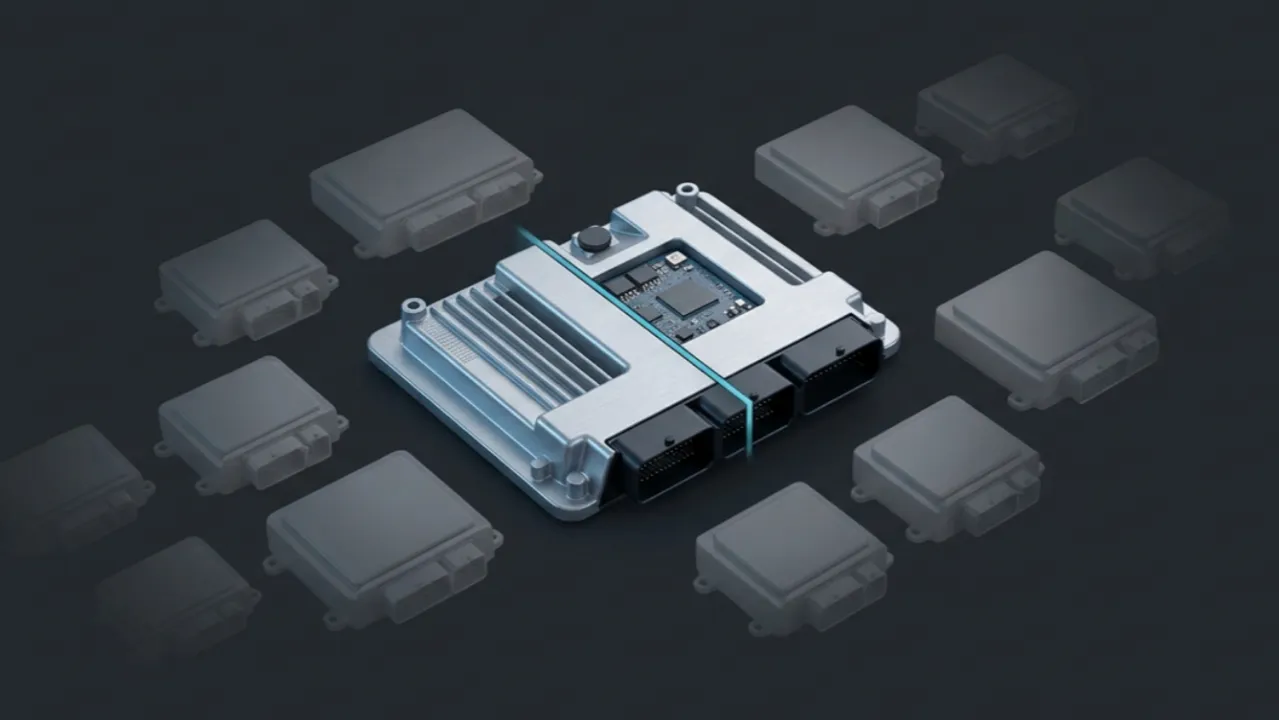
At CES 2026, Leapmotor and Qualcomm showed off something that looked, from a distance, like a modest engineering update: a single central computer, built around two Snapdragon Elite chips, that runs the cockpit, the driver assistance system, the body controls and the vehicle gateway of Leapmotor's new D19. It is a genuinely notable machine, the first mass-production example of its kind. What it replaces is the interesting part. A car built this way used to carry a dozen or more separate control units for those same functions, each one wired, powered and validated independently, each one able to fail on its own without taking anything else down with it. Consolidate all of that onto one board, and you have solved a real cost and complexity problem. You have also, quietly, created a new one, and the industry's answer to it is a piece of hidden engineering that deserves far more attention than the TOPS figures currently getting all the headlines.
The economics of killing forty ECUs
The pitch behind central compute is straightforward and, on its own terms, correct. NVIDIA's DRIVE Thor, built for up to 2,000 TOPS, was announced explicitly as a centralised car computer unifying cluster, infotainment, automated driving and parking into one system. Geely's ZEEKR brand put Thor into production in early 2025, and BYD, the world's largest EV maker by volume, has expanded its own collaboration with NVIDIA to build next-generation fleets on the same platform. Qualcomm is chasing the same shift from the other direction: its Snapdragon Cockpit and Ride Elite platforms now cover design wins with Li Auto, Leapmotor, Zeekr, Great Wall Motor, NIO and Chery, and Volkswagen has signed a letter of intent to make Snapdragon Digital Chassis the primary compute provider for its next zonal software-defined-vehicle architecture. That single relationship helped push Qualcomm's automotive design-win pipeline to $65 billion, with a $10 billion automotive revenue target set for fiscal 2029. The hardware segment of the wider central compute platform market, valued at roughly $3.7 billion in 2025, is forecast to reach $17.1 billion by 2034. None of this is speculative. It is shipping.
Every one of these programmes is sold on the same logic: fewer boxes, less wiring, lower bill-of-materials cost, and a software platform flexible enough to add features after the car has left the factory. That is a real and valuable outcome. It is also only half the engineering story.
The problem the pitch skips
Automotive functional safety does not care how many chips a manufacturer would prefer to use. ISO 26262's ASIL-D requirement, the standard applied to steering, braking and other functions where a failure could plausibly kill someone, demands that a safety-critical fault be detected and that the vehicle be brought to a minimum risk condition, typically a controlled stop, regardless of what else is happening in the system. In the old distributed architecture, that requirement was relatively easy to satisfy because the functions were physically separate. If the infotainment ECU crashed, it took the radio down with it and nothing else. Steering assist lived on its own silicon, with its own power path, unaffected.
Collapse cockpit, ADAS, body control and the gateway onto one or two chips, and that physical separation disappears. A central compute node that cannot detect its own internal failure and independently force a safe stop does not meet the safety bar for the steering and braking functions it is now also responsible for. This is not a hypothetical concern raised by critics of consolidation. It is a design constraint that chip vendors and OEMs are actively engineering around right now, because the alternative is a central computer that is powerful, efficient and legally unfit for the safety-critical role it was built to play.
The silicon answer: a second brain on the same die
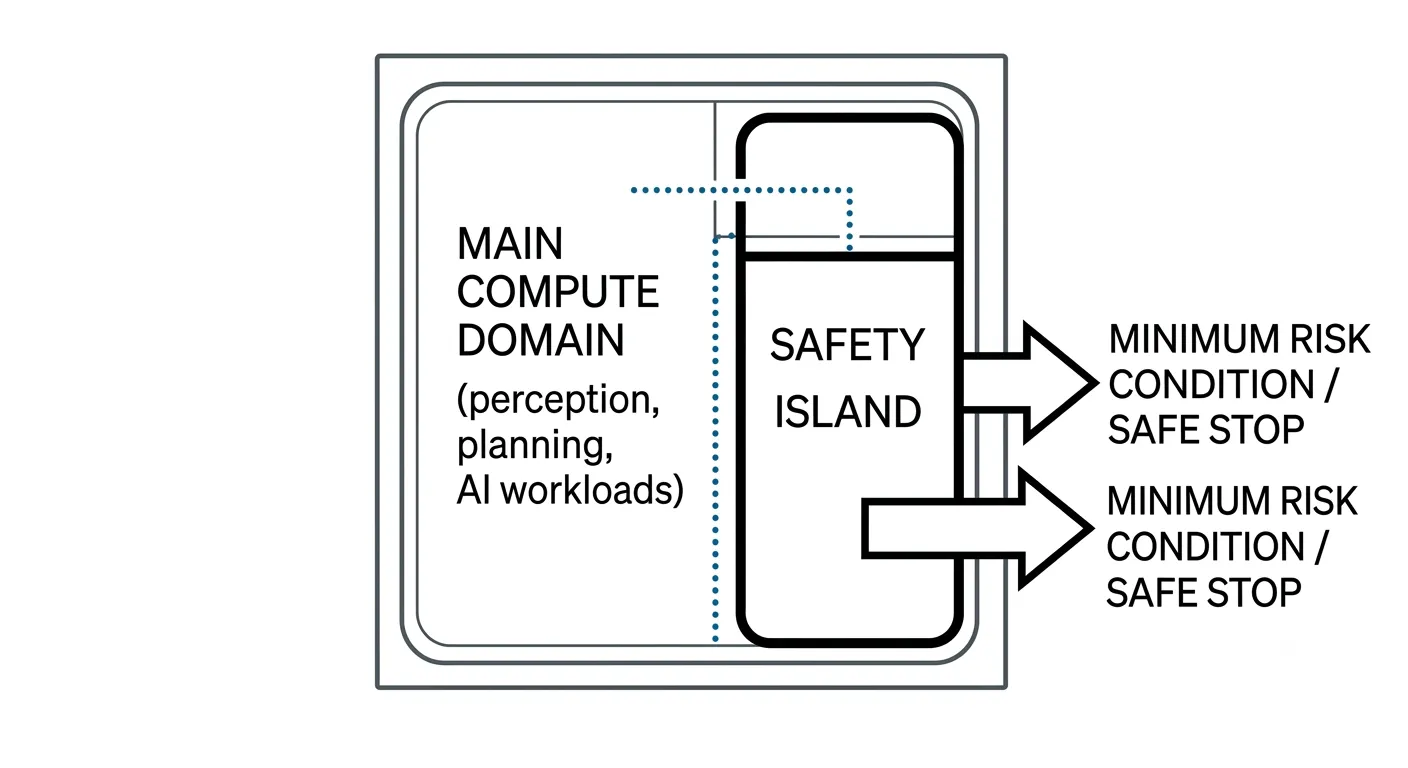
The industry's actual solution is called a safety island, sometimes formalised as SAIL architecture, and it works by splitting the chip itself rather than the car. A modern ASIL-D-capable SoC is partitioned into a main compute domain, which runs the full perception, planning and AI workload, and a separate, deliberately leaner safety island domain, which checkpoints what the main domain is doing and monitors for faults in either side. Critically, the safety island is built to keep functioning and to force the vehicle into a minimum risk condition even if the main domain has crashed completely. It is, in effect, a second brain sharing the same package as the first, existing solely to watch the first one and pull the plug safely if it stops behaving.
Renesas took this a step further at ISSCC 2026, held in San Francisco in mid-February, presenting an architecture that preserves ASIL-D guarantees even when the compute is physically split across multiple chiplets rather than one monolithic die, a configuration increasingly used to manage cost and manufacturing yield. Their approach combines the UCIe die-to-die interconnect standard with a RegionID scheme that assigns and polices hardware resources, specifically to stop one application interfering with another when several workloads share adjacent silicon. This is a genuinely difficult real-time systems problem: guaranteeing deterministic, safety-rated behaviour across a boundary that used to be a physical gap between two separate boxes and is now a few millimetres of interconnect on a shared substrate.
What to watch
The stakes here are not abstract. Software and electronics defects were the single most prevalent NHTSA recall category in 2025, with 119 campaigns covering roughly 8.2 million vehicles. BMW recalled almost 37,000 model-year 2025-2026 X3s in December 2025 after a steering software weakness that could produce unintended steering wheel movement while stationary. Hyundai recalled over 421,000 Tucson and Santa Cruz vehicles after a front-camera software bug caused unexpected braking, linked to four rear-end crashes. Both recalls involved single functions on largely separate hardware. Central compute concentrates far more of that safety-critical surface onto fewer, shared nodes, which is precisely why the safety-island discipline matters so much and why it is worth watching closely rather than taking on faith.
Three things are worth tracking over the next year. Whether chip vendors and OEMs start publishing real validation evidence for their safety island implementations, rather than leading every announcement with a TOPS number and leaving the fault-handling architecture as a footnote. Whether standards bodies formalise chiplet-specific ASIL-D guidance quickly enough to keep pace with hardware that is already shipping, given Renesas only presented its approach in February 2026. And whether the next wave of software-related recalls starts naming central compute nodes rather than single-function ECUs, which would be the clearest possible signal that the safety island discipline is not keeping up with the consolidation it is meant to protect.
Central compute has not eliminated the redundancy that a distributed E/E architecture used to provide for free. It has relocated that redundancy onto the same die, where it is far harder to see, harder to test independently, and easier to under-resource under commercial pressure. As more manufacturers follow Leapmotor, ZEEKR and BYD onto this path, which matters more to the industry's next safety record: how many TOPS a chip can deliver, or how convincingly its vendor can demonstrate that the second brain watching the first one actually works?
This piece first appeared in ASG's Hello, Auto! newsletter on LinkedIn.